Wednesday, August 8, 2012

XBMC will turn the $99 Ouya gaming console into a media center ...

The Ouya is a $99 video game console with an NVIDIA Tegra 3 quad-core processor, 1GB of RAM, 8GB of storage, WiFi, Bluetooth, and USB ports. It runs Google Android 4.0, comes with a wireless game controller, and it?s designed as a low cost platform for playing Android games on a big screen TV.

But it can also run apps that aren?t games. And that means that you could use the $99 set-top-box for a variety of purposes. One of the most obvious? A media center PC. It turns out there?s an app for that.

Ouya XBMC

XBMC is a media center app for Windows, Mac, and Linux computers. The developers are working on an Android version, and now they?ve announced that they?re working with the Ouya team to make sure that it runs on the $99 box.

This isn?t exactly a first? XBMC started out as Xbox Media Center, a project for transforming the original Microsoft Xbox video game console into a media center before the project branched out to support other hardware.

XBMC provides a full-screen interface for navigating music, movies, pictures, and other media using a TV and remote control. It also supports dozens of plugins that let you stream media from websites including Hulu, Amazon, Grooveshark, and NPR.

XBMC

While the Ouya console only has 8GB of storage, it would make a pretty great media center if you plug in a USB hard drive for extra storage or stream media from a shared network drive. You could also use it to do nothing but stream media from online audio and video sites, and it?d be sort of like a more versatile Roku box.

The only catch is that neither the Ouya console nor the XBMC app for Android are available yet. Ouya is still in the fundraising stages, and plans to start shipping developer units to donors in December and finished products to customers in March, 2013. Pre-orders through Kickstarter end on August 8th, 2012.

The XBMC app is still under development. The developers have released the source code, but if you want to try out XBMC for Android on an existing phone, tablet, or mini PC, you can download a pre-compiled (but beta) build from the Miniand forums (among other places).

If you're new here, you may want to subscribe to our RSS feed, follow us on Twitter, or "like" us on Facebook. Thanks for visiting!

  • Game formatDownloadable
  • Drive capacity8 GB
  • Controller typeWireless
  • Video outputsHDMI
  • Announced07/10/2012
see all specs ?

There are not any user reviews for this product yet.
Why not be the first to write one?

Get better reviews from people who actually have this product!

write a review Posted on Tuesday, August 7th, 2012, 8:59 am by Brad Linder

Source: http://liliputing.com/2012/08/xbmc-will-turn-the-99-ouya-gaming-console-into-a-media-center.html

mlk memorial heather locklear hospitalized joplin tornado extreme makeover home edition constitution day constitution day coachella 2012

J&J, Pfizer to drop intravenous Alzheimer's drug

NEW YORK (AP) ? Pfizer Inc. and Johnson & Johnson said Monday they are ending development of an intravenous formulation of a drug to treat Alzheimer's disease after the treatment failed in two late-stage clinical trials.

The companies said bapineuzumab intravenous did not work better than placebo in two late-stage trials in patients who had mild to moderate Alzheimer's disease.

The drug is designed to prevent the buildup of plaque in the brain. J&J said it is not discontinuing development of the compound and noted it has ongoing studies including a mid-stage neuroimaging study with bapineuzumab delivered subcutaneously.

Johnson & Johnson made a big bet on bapineuzumab in 2009, agreeing to invest up to $1.5 billion initially. The two companies said July 23 that the drug had failed in a different trial.

Johnson & Johnson, based in New Brunswick, N.J., said it will take a charge of $300 million to $400 million in the third quarter.

Dublin-based Elan Corp. PLC, which licensed the drug to Johnson & Johnson in 2009, said it will take a $117.3 million charge of its own.

U.S.-traded shares of Elan lost 10 percent, or $1.34, to $11.91 in after-hours trading. Shares of New York-based Pfizer lost 2.7 percent, or 66 cents, to $23.60. Johnson & Johnson stock edged down by 84 cents, or 1.2 percent, to $68.

Current treatments for Alzheimer's can only temporarily ease symptoms of the disease, which include increasing memory loss, confusion, wandering and aggression.

In the latest trial, bapineuzumab was tested on about 1,300 patients who lacked a gene that is associated with a greater risk of Alzheimer's. Last month the companies said the drug also didn't work on patients who do have that gene. Pfizer and Johnson & Johnson were running two other late-stage trials as part of a very large testing program for the drug.

Worldwide, about 35 million people already have dementia, of which Alzheimer's is the most common type. In the U.S., about 5 million have Alzheimer's. Finding a drug that could at least slow the disease has become a sort of Holy Grail in the pharmaceutical industry. A successful medicine would be guaranteed to generate billions in annual sales, given the world's aging population.

Associated Press

Source: http://hosted2.ap.org/APDEFAULT/bbd825583c8542898e6fa7d440b9febc/Article_2012-08-06-Pfizer-JandJ-Alzheimer's%20Disease/id-4d95ccb0cdff405184bef462153165a0

obama sweet home chicago accenture match play george washington carver king cake mardi gras fun. hepatitis c symptoms

Tuesday, August 7, 2012

Acquiring Probably the most From your Subsequent House ...

When contemplating about home enhancements, some house owners get afraid. Maybe they think the trouble, mess, headache and cost of home improvement are just too mind-boggling. However, improving a home doesn?t must be hard. A house owner who plans thoroughly and educates themselves around the venture can get excellent final results with minimum efforts.

When you plan a venture, make certain to put aside a spot for debris. Demolition could make rather a mess, and you will will need a space for it. By planning ahead, you will be confident you already know precisely the place this mess goes, which means you do not have mini trash piles developing up all over.

Make sure to near the curtains of the home to protect your rugs and carpeting. The light from your sun can bleach your carpet, but only inside the spot the sunlight hits. Working with furnishings to block the sun?s damaging rays or only opening the drapes once the sun?s light is significantly less extreme can assist to protect your carpet.

In the event you are making use of home improvement to increase the worth of the home, contemplate the porch. It truly is among the initial things a visitor sees. Add some potted plants and put fresh paint up. You could be stunned how promptly your property rises in worth over the authentic investment. This is a single spot of home improvement the place small efforts can yield significant rewards.

It is best to periodically hire a contractor to inspect your chimney for hazards and clean out any debris. This is extremely critical in case you use wood to heat your property, but nevertheless critical in case you will not. Or else, toxic fumes may be released into your property or fires may be sparked. So, add a chimney inspection to your home improvement list and ensure your security.

In the event you reside within a spot that tends to flood or that experiences hurricanes, buy ?hurricane socks? for the home. This fabric can absorb upwards of a gallon or more of water. These could be installed at entrances of doors and windows.

In the event you plan on renovating your bathroom, contemplate making it handicap accessible. In the event you are planning to continue to be with your home until finally old age, attending to this alter inside of the bathroom earlier in lieu of later on can save hassles inside the long term. In the event you are planning to offer inside the long term, all these items will boost the sale price tag.

It is possible to create a room with your home truly feel fresh and new by updating the floor covering. A respected flooring business can install new hardwood, carpet, laminate or tile flooring in as tiny as a single day. Alternately, you may pay a visit to your nearby home improvement store for do it oneself options.

Waste disposal is a vital portion of any home improvement venture. Make arrangements ahead of time for storing and getting rid of the debris that your up coming venture is going to develop. Removing debris can expense a great chunk of alter, and developing a storage plan ahead of time can assist preserve expenses down and can make sure your venture can keep on without any delays.

This article stated that it is crucial that you simply know whenever you are in over your head with home enhancements. In the event you stick with the suggestions shown, then you certainly is going to be preventing oneself from producing high-priced or even catastrophic mistakes. It truly is much better to request help than to regret an error for your rest of the life.

Invested 2002-2010 exporting dandruff globally. Invested 2001-2007 analyzing birdhouses in Deltona, FL. Had moderate good results merchandising bacon in Nigeria. Invested 2001-2005 merchandising Elvis Presley in Ohio. Invested 2001-2006 merchandising clip-on ties in Nigeria. Invested a number of many years producing promoting channels for yogurt on Wall Street.
Think it is right here

Source: http://www.freedownloadsfiles.com/uncategorized/acquiring-probably-the-most-from-your-subsequent-house-improvement-project.html

apostasy canon powershot elph 300 hs christmas lights canon eos rebel t3 christmas photo cards ar 15 costco

NBA Rumors: Why Kobe Bryant Will Never Finish His Career in Europe

It seems for the past two Olympic Games we've been inundated with little rumblings about Los Angeles Lakers shooting guard Kobe Bryant bolting the NBA to ride off into the basketball sunset in Europe.

Bryant, who is fluent in both Italian and Spanish, has long had the largest international following of any NBA player and has strong ties to Italy after spending seven years there as a child.

At 2008's Summer Games in Beijing, Bryant sat down with Yahoo! Sports' Adrian Wojnarowski to discuss possibly playing overseas. At the time, Bryant was heading into the opt-out year of his contract and had just told the Boston Globe a day earlier that he would "probably" leave Los Angeles for Italy if offered $50 million.

Bryant elaborated to Wojnarowski:

As players, the business of the game (is) evolving. I think free agency now is becoming a global thing ?. When players become free agents, the team they?re currently with ? their competition is no longer the rest of the teams in the NBA. But it?s global. So, the market?s opened up. So we?ll just have to see how the league responds to it.

As we should have then, we all know now that the hypothetical $50 million was nothing more than a false narrative built on fairytale European money. We also know that Bryant certainly wasn't going to leave after winning an NBA championship in 2009.

And with after signing a three-year, $83 million contract extension in 2010, the time for Bryant, who turns 34 on August 23, to play in Italy or elsewhere overseas during his prime has passed.

That certainly isn't going to stop the European narrative, though.

Again two years away from free agency, Bryant talked the overseas possibility with Wojnarowki for a second time this week in London. Only this bit of European speculation centered around Bryant heading over as a 36-year-old man taking his basketball "victory lap."

But, simply put, talks of Bryant finishing his career overseas has about as much chance of happening as that $50 million from 2008.

Here's a look at a few of the biggest reasons why.

?

Bryant Has a Family to Worry About

When Kobe's father, Joe, uprooted the family and took them to Italy, it was to extend a basketball career that was over at the NBA level.

His son won't ever have that problem.

Kobe Bryant will be able to play in the NBA for the Los Angeles Lakers until he decides to retire from the league or until his legs fall off. Those are the only two scenarios that can end the shooting guard's Lakers journey.

That means Bryant would have to make the executive decision to move his family from their L.A. roots to Europe. That's not exactly easy when you have two school-aged children who have lived in one place their entire lives and a marriage that just narrowly avoided divorce in June (via TMZ).

And while I'm certainly in no place to tell someone else what to do with their family, it seems highly unlikely that Bryant would choose to uproot his family just two years after such a tenuous situation.

There's a total difference between an extended European vacation and fundamentally altering your familial structure.

?

European Paychecks Aren't Exactly Reliable

Sure, if he heads overseas, Kobe Bryant is getting paid every cent he's due.

But that's likely not the case for his European teammates.

Just ask current Phoenix Suns forward Josh Childress. After signing a three-year, $20 million deal with Greek club Olympiacos, Childress spent two years playing overseas.

In an interview with ESPN's Ric Bucher (subscription required) during the 2011 NBA lockout, Childress detailed the difficulties of getting paid overseas.

One of the biggest things guys will have to realize is that whatever offer you get, there's no guarantee you'll actually get all that money. If a guy isn't playing well or a team is out of the playoffs, they'll just stop paying you.

And if those paychecks stop coming in for fringe European players, Bryant's (assumed) exorbitant salary will certainly cause scorn from teammates.

With no NBA owners doling out checks that bounce and the "get all your paper" NBA player mindset, why would you leave? For an ownership stake in a minor league franchise that doesn't make enough money to pay its players?

If Bryant wants an ownership stake in a basketball franchise, it would take a 15-second phone call to Jerry Buss.

?

Bryant Is a Competitive Person and the Top Talent Is in the NBA

In his interview with Wojnarowski this week, Bryant was seemingly opening up the possibility of playing overseas, but all the while closing the door completely.

You'd have to look at the market and what's going on in terms of the level of basketball being played. I understand there's a high level of competitive basketball in Turkey now. They might have the best league in Europe. Spain has obviously been one of the top leagues for a long time.

And Italy is a place that's dear in my heart, I grew up there, but the level is not where it used to be. When I was growing up over there, that was the best league in Europe.

That quote should seal the deal on Bryant's international flirtation by itself.

The European narrative was once about Bryant wanting to finish his career in Italy and becoming an international basketball ambassador. Kobe would simply head overseas, collect his checks and build a global marketing brand that extends far past his playing days.

Where will Kobe Bryant finish his NBA career?

    Where will Kobe Bryant finish his NBA career?

  • Los Angeles Lakers

  • A European Team

  • Another NBA Franchise

Bryant's quote now tells you he's more interested in finding the best level of European competition than brand building.

And news flash: No European leagues even come close to rivaling the NBA in terms of talent, coaching, infrastructure, etc.

Hypothetically, a 36-year-old Bryant would (likely) have to leave the NBA with gas still in the tank, give up whatever guaranteed money the Lakers offer in his next extension and uproot his entire family...all to play in the minor leagues.

Yep, keep dreaming.

While it's a pretty narrative, Kobe Bryant's last minutes as a basketball player will not come on an overseas court, but the way they should?as a Los Angeles Laker.

Source: http://bleacherreport.com/articles/1286944-nba-rumors-why-kobe-bryant-will-never-finish-his-career-in-europe

Tropical Storm Debby Lolo Jones fox news legend of korra lebron james magic mike trailer Alan Turing

Apple, Google bid on Kodak patents - report

(Reuters) - Eastman Kodak , which is planning to auction 1,100 digital patents, received two bids from investor groups including Apple Inc and Google Inc of between $150 million (96.2 million pounds) and $250 million, the Wall Street Journal reported on Monday.

Bankrupt Kodak is selling the patents, which it believes could be worth $2.6 billion, in order to repay creditors. The company filed for Chapter 11 protection in January after failing to keep up as consumers and rivals shifted to digital photography from film photography.

A spokeswoman for the company declined to discuss the report in detail, citing court-ordered confidentiality surrounding the auction process.

"Kodak believes that speculation about the details and potential outcome of the auction is inappropriate," spokeswoman Stefanie Goodsell said on Monday.

Bids can rise quickly in bankruptcy auctions. Nortel Networks Inc in 2011 sold its patent portfolio for $4.5 billion after initial bids came in at just $900 million.

Kodak's auction is slated to begin on Wednesday morning.

(Reporting By Nick Brown; Editing by Jacqueline Wong)

Source: http://news.yahoo.com/apple-google-bid-kodak-patents-report-005923449--sector.html

dallas weather nike nfl uniforms ben and jerrys free cone day tornado in dallas texas the island president the maldives harper lee

Monday, August 6, 2012

Russia mogul under pressure wants to sell assets

(AP) ? A Russian tycoon whose holdings include a leading investigative newspaper critical of the Kremlin said Friday that he wants to sell his Russian assets because of pressure from state security services.

Alexander Lebedev, worth $1.1 billion according to Forbes magazine, said the main KGB successor agency has targeted him with a series of investigations and inspections to push him out of business.

"For the past three years my business has been deliberately and continuously destroyed by Division K of the Federal Security Service's economic security department," Lebedev said on his blog. "Haunting and pressure has targeted not only me and workers of my companies, but my family members as well."

He said the main reason behind the Russian Federal Security Service's pressure on him was corruption investigations by the Novaya Gazeta he has financed, alleging that some of its officers were involved in corruption.

Lebedev and former Soviet leader Mikhail Gorbachev own a 49 percent stake in the newspaper, while the remaining shares are controlled by Novaya's staffers. Lebedev also owns two newspapers in Britain, the Independent and the Evening Standard.

The Novaya Gazeta's relentless criticism of the Kremlin and its investigations into official corruption have put many of its journalists under fire. Four of its reporters have been killed since 2000, including Anna Politkovskaya, a fierce critic of the Kremlin and its policies in Chechnya who was gunned down in the elevator of her Moscow apartment building in 2006. Others have been harassed and attacked.

Lebedev said on Ekho Moskvy radio that he may hand over some of his assets to Novaya so that the newspaper may continue operation, because he no longer has no cash to keep funding it.

Lebedev has also supported Alexei Navalny, a charismatic anti-corruption crusader and blogger who was a key driving force against massive protests in the past winter against Vladimir Putin's rule. Earlier this week, Navalny has been charged with theft amid a widening crackdown on dissent that followed Putin's re-election to a third term in March. He may face 10 years in prison if convicted.

Lebedev, a KGB veteran like Putin, has avoided blaming the president for his woes. He said that security officers targeted him because he was the "main sponsor of the opposition," but dismissed that claim as "utter rubbish." He added, however, that he had expected the Kremlin to intervene to stop attacks on him.

Lebedev has made his money in the banking industry and owns the National Reserve Bank. He also has a stake in Russian flag carrier Aeroflot and owns Red Wings airline and other assets.

Lebedev said that it would be hard for him to sell his assets because the security services would discourage any potential buyers. He said he had no intention of leaving Russia, adding that he would try to take a more active role in politics.

Associated Press

Source: http://hosted2.ap.org/APDEFAULT/f70471f764144b2fab526d39972d37b3/Article_2012-08-03-Russia-Tycoon%20in%20Trouble/id-9414f0be1c4e4244b70315d05a5c462b

mythbusters blago mumia abu jamal mumia abu jamal pearl harbor blagojevich sentence mythbusters cannonball

A Speculative Alternative To Investing Part 5: Dividend Stocks ...

(part 1, part 2, part 3, part 4)

Last time we determined that beta neutral spreads are the perfect instrument to use in our speculative?portfolio. ?Now we need to decide which spreads. ?Sadly, that?s as open ended a question as ?Which stock should I buy??. ?What I?m going to share with you here is a technique I?ve developed that seems to give good returns on relatively low risk.

Years ago, before I decided that conventional investing was a bad idea, I spent a lot of time looking into dividend stocks. ?There are of course portions of the financial internet that are flat out in love with dividend stocks. ?Usually they throw in a good dose of Warren Buffett fanaticism for good measure. ?I?ve come to believe that the Buffett stuff is 90% bullshit, but that?s a story for a different day. ?The main point is that I was looking at a lot of high-dividend stocks, and if I was going to buy them as investments I wanted to get a good deal. ?So I asked a very simple question: How do I know when a dividend stock is cheap?

One potential answer lies in the theory for pricing cash flows. ?If we model a dividend stock as simply providing a guaranteed series of dividend payments, then the stock functions in effect turns into the interest-only (IO in bond trader lingo) portion of a AAA bond. ?And like any bond, its price should move opposite of yield. ?This simplistic model suggests that dividend stocks should behave in an odd fashion ? when the market is in the dumps and drives T-bond yields down (and bond prices up), dividend stocks should move with them. ?Yield down, price up.

Now, if you look at the way the market actually behaves, you?ll see this phenomenon happening on the long term but not on the short term. ?We?ve now had almost 4 years of persistently low bond rates since the 2008 crash. ?Initially, nearly every dividend stock tanked along with the rest of the market, which is contrary to the theory above. ?But during the recovery they?ve outperformed, with most exceeding their 2007/8 highs as low bond?yields?cause yield-seeking behavior and drive money into the safer segments of the stock market.

Any time you see a relationship that holds in the long term, but not in the short term, you should start to get the feeling that there?s money to be made betting against the short term. ?Which is exactly where I?m going, but we need to make a few more stops along the way. ?My model of treating a dividend stock as a long-term IO bond has some flaws. ?First off, it assumes a constant dividend rate into the future when in reality successful companies can increase their dividend over time. ?Similarly, it assumes a zero chance of the company failing which is clearly unrealistic. ?These differences between theory and reality making pricing dividend stocks via fundamentals much harder than I?ve implied ? in fact so hard that maybe no one does it consistently well. ?I don?t claim any particular?expertise. ?In fact, I?m rather lazy so I?d like to avoid the problem at all and let the market do as much work as possible for me. ?Which raises a second question: What can the market tell me about correct pricing for a dividend stock?

One thing we do know about certain stocks with long-standing dividends is that they?re boring. ?Because most of the earning are returned to the shareholders, growth is limited. ?This is both good and bad. ?It reduces the?likelihood?of the company embarking on some new and profitable enterprise, but it also prevents them from spending money on some idiotic turkey of an idea. ?Large dividends mute both the upside and downside potential, and thus the historic?behavior?of a dividend stock is probably a pretty good indication of where its going. ?This leads us to a another simplistic model for dividend stock pricing:

The correct price of a dividend stock is its average price over some period of time. ?The distance between the current price and the average price, measured in standard deviations, tells us how mispriced it currently is.

Now once again this is a painfully simplistic model that misses all sorts of real issues. ?But it?s a starting point in that it uses the market, via averaging and standard deviation calculations, to get a handle on all the problems with our first bond-based pricing model. ?In order to understand how this new model works it?s helpful to look at the price chart of a dividend stock annotated with a moving average of price and standard deviation bands for price. ?This sort of chart is frequently referred to as Bollinger bands, and you don?t need a complicated charting package to see them. ?Google finance charts includes a perfectly usable version. ?As an example I?ve charted 3 years of weekly bars of NWN stock, which is a long-standing dividend paying natural gas producer. The moving average (middle) line has a 20 week period and the Bollinger bands are set two standard deviations out:
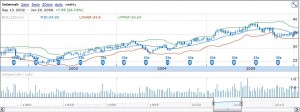
You can see that over a 3 year period NWN saw only limited price change in the $25-40 range. ?These are actually three of the more exciting years NWN has had, which is why I chose them for the example plot since our eventual strategy will be based on a lack of long term volatility, and if it still works in the face of some long term moves then it will likely work consistently.

Now, there?s something wrong with this chart, but if you don?t know what to look for you?d likely never spot it. ?It turns out, if the pricing of an instrument is efficiently generated by a random walk, that it will spend about 2.2% of its time more than 2 standard deviations above the average price and the same amount of time 2 standard deviations below. ?That means in the three years covered by this chart, we would expect about 7 of the 156 weekly closing prices to be outside the Bollinger bands. ?A whopping seventeen of them are. ?In other words, the distribution of prices here does not look the way we would expect. ?Instead of having the typical normal distribution that a random walk and the central limit theorem would imply, it must be fatter in the ?shoulders? of the curve slightly past 2SD and therefore thinner in both the tails and middle. ?It turns out this pattern repeats for a large family of dividend stocks. ?Hmm?

Thin tails correspond directly to part of our theory about dividend stocks ? namely that they ?re boring and don?t exhibit massive long term price moves. ?But the relatively thin middle is odd ? that means price has a tendency to blow from one extreme to the other, lingering in the middle less than you would expect. ?In other words what we?re seeing here is a sort of mean reversion behavior with overshoot ? prices go to one extreme, and then more often than not move back to the middle, overshoot, and go to the other side where the pattern repeats. ?The stock is boring at extreme prices, but surprisingly mobile in the middle. ?You can see this phenomenon in the chart above ? the average bar that crosses the middle line is bigger than the average bar that doesn?t.

At this point, we could simply stop thinking and lay out our trading strategy: buy dividend stocks when they close below the lower 2 SD band. ?Sell to close when they revert to the mean. ?Similarly, sell short when they close above the 2 SD band and buy to close at the mean. ?This I would argue is a winning strategy, but it?s not best from a risk perspective and it lacks a good solid explanation as to why it works. ?For that explanation we need to talk about program trading.

Program trading is, in essence, the man behind the curtain in the stock market. ?Not that there?s anything particularly sinister about it, but program trading is both the dominant force in equities and almost completely ignored or misunderstood by the public and retail traders. ?Slightly over 50% of stock trades have a program trade as one side or the other and program trades make up 30-40% of daily share volume on the major exchanges. ?This number has been growing.

A program trade is defined as any time one party in the market trades simultaneously in a large basket of stocks. ?Program trades are so named because, if you want to trade a bunch of stocks at once, you need a computer?programmed?to do it. ?By itself the term doesn?t imply why someone is trading so many stocks at once, just that they?re doing it. ?That said, most program trades follow a certain internal logic which can best be explained in the context of index futures and index arbitrage. ?An index future is simply a vehicle for trading the value of some stock index in a clean way. ?For example, the ES future represents the S&P500 index. ?Now, it should be obvious that there?s an arbitrage relationship between the index future and the stocks comprising the index. ?If the futures go up the stocks should go up and vice versa. ?Index arbitragers police this relationship. ?If someone comes along and buys a bunch of ES, the arbitrageurs sell them the ES and buy the 500 components of the S&P500 to get back to a conceptually flat position. ?As you?ve probably guessed, buying 500 stocks at once is a program trade.

There are a lot of complex variants on program trading, but they all follow the same basic logic. ?You have some basket of stocks, and some opinion about what they ?ought? to be priced at. ?Perhaps you?re trading oil company stocks vs. oil prices. ?Perhaps you?re trading healthcare stocks vs. a healthcare ETF. ?Perhaps you?re trading troubled?companies?vs. an index that tracks their?likelihood?of bond default. ?But the key point is you?ve got a basket of stocks and something that you think tells you what the price should be. ?When the basket is overpriced, you sell. ?When it?s underpriced, you buy.

Now, you may be wondering what this has to do with our dividend stocks. ?The answer is this: I believe program trading distorts the price of dividend stocks. ?The reason is that most non-program trading people active in dividend stocks are following very conservative Benjamin Graham style investment strategies. ?These strategies have very widely seperated buy and sell points defined by something Graham called the ?margin of safety?. ?In essence, you buy only when things are very cheap, sell only when very expensive, and sit tight the rest of the time. ?What this means is that if you push the price of a dividend stock low enough via program trading, the market will suddenly firm up as Graham style investors achieve the margin of safety they need to invest. ?Similarly, if you push prices high enough you?ll exhaust their margins and cause them to sell, putting in a ceiling.

This, I think, explains the ?slow moving at extreme prices, fast moving at average prices? phenomenon we saw in the charts. ?And it?s definitely a tradeable inefficiency. ?Here are the trading rules I?m currently using:

  • Build a watch list starting with the dividend championstocks
    • Eliminate all stocks with dividends greater than earnings or projected earnings
    • Eliminate all stocks with market caps less than $1B or known to have very thin markets
    • Eliminate all stocks that exhibit strong trending behavior
    • Eliminate all stocks with a beta less than 0.6 (this gives us the most boring ones, plus has some portfolio allocation advantages)
    • Re-build the watch list each year.
  • The watch list for 2012: ABT, BMS, CLX, GPC, JNJ, NWN, PEP, PNY, PG, SYY, WGL
  • Wait for one of these stocks to move more than 2 standard deviations from the 20-bar mean on weekly bars. ?Then wait for it to move slightly towards the mean. ?Then enter a beta-neutral spread betting the stock will return to the mean value.
  • Exit this spread when the stock returns to the mean value.

And there you have it: the top secret method. ?There?s still quite a few things we need to go over ? portfolio allocation, risk management, and what if anything we want to do about bonds and commodities. ?But this is the guts of the speculative alternative to investment.

The next installment will cover the last of the details, lay out a model portfolio, give you a spreadsheet to build your own, and report some initial performance results.

Source: http://www.offroadfinance.com/2012/08/06/a-speculative-alternative-to-investing-part-5-dividend-stocks-program-trading-and-picking-our-spreads/

st. nicholas st. nicholas heisman finalists heisman finalists kepler 22 b kepler 22 b st nicholas

The introvert's guide to the writing world. | madgeniusclub

A couple of comments on Sarah?s blogs struck me both pointedly and poignantly and over the head (because that?s the surest way to finally get my attention) ? writers being entertainingly snippy? but admitting that in real life they were mice. Quiet, un-noticed and invisible in a crowd of three. Preferring our own company and a good book to the noise and chitter-chatter.

Did you nod? Say: ?That?s me.??

Looked at superficially, writing is a perfect choice for the likes us. After all it?s all about words, innit? Stringing them together in like perfect pearlescent beads, weaving it into a broad rich usekh, or a diadem cunningly wrought with rich jewels. Then readers put them on and marvel and revel in them.

Yeah right.

By design? or by intention? or they just forgot to mention? that there is no easy linkage between reader and writer. And the most brilliant of word-strings cast no scintillating light in a bottom drawer. Eventually those of us with lofty ambitions? well, beyond being read by passing earwigs (in the dark, too), figure this one out. But never fear! There is the sweet anonymity of the brown A4 envelope (and now, in a few spots, even online submission).

And that, after that those strange kindly creatures, the publishers will do all the rest. That, after all, is why you give them 6% of the cost of the book. Which is quite generous, really, after all the hours and heartache you put into writing it (that?s right, isn?t it?).

Day-after-day you trudge the trudge, shoulders stooped beneath the load of waiting and fear? to the mailbox. Eventually you probably get the form rejection letter, and know the bleakness of the unloved writer.

Which may just be the best thing that could happen to you. You may turn to the Internet, or books on how to, and discover either agents or doing it yourself.

If, like me, you are close to terminally shy about the whole interfacing with other people about your book and ?selling? it? you may like the agent-who-will-sell-it-to-the-publishers option. Remember those publishers ? they?re the ones who are going to do all the tedious process of getting readers to experience that sequined loin-cloth of a book of yours, for the 6%. Only the agent want 15%. It all seems a bit unreasonable, but what is an introverted mouse to do? Ack! Go out and tell people what a wonderful book it is, and they should try it? You mean, like actually? uh, speak to strangers, not just eavesdrop and put the bits of their conversations in your next book. And worse, speak to strangers about your writing.

So: you bite the bullet? agree to the agent?s terms, and lo and behold, in the fullness of time? they sell your book. Now, the fullness of time varies, if you?re a cheerful (and totally disproportionate to population demographic odds, physically attractive, young, probably female, or at least officially anointed PC victim, loudly extrovert and supportive of the right party line, and selling a PC book which parrots the agent and publisher?s prejudices well. Strange, despite the mathematical improbability of this, this happens? a lot. The chances ought to be enormously slim. If someone wants to do the stats, I think you will find the bias is far worse than discrimination against any officially designated ?victim?) it?s a short fullness, and you may find with your personality, your publisher then gives you all the support and assistance you could possibly want.

If you?re like me, a quiet guy/lass who likes the big silences, who by choice listens more than says, and doesn?t do crowded rooms well, let alone chatrooms? Welcome to hell, my friend. Because you will find that the difference between self-publishing and being traditionally published is? that YOU get 6%(newbies paperback rate) out of which you pay your agent 15%, as opposed to 70%.

Your publisher may (or my not) provide good editing/ proof reading. They will provide a cover. They may (or may not) get your book into traditional brick and mortar bookstores.

And that is where the difference ends. Well, as an independent you will not get an advance and will have to get your cover and editing and proofing done.

But when it comes to making the vital contact between your book and the reader, other than the accidental encounter in the ever-shrinking bookstore, and its ever decreasing shelf-time, everything else that traditional publishers have been able to shove off on authors has been. And mostly it is at your expense, and ALWAYS it is on your time and ALWAYS it is on those non-existent self-selling skills. Which is more or less where the self-published introvert got to, at the rejection letter and deciding to go it alone on the quality of their work.

Sadly, quality only counts when someone ACTUALLY reads it. And yes, you?ll lose them if your editing, proofing and cover are lousy. But? a lot of introverts also seem to be perfectionists. So we return to getting people to try the book? with an ill-equipped sales-force of one shy person. Which may explain why so many ?successful? writers
would rather be with people they don?t like, than alone. Who find a coffee-shop a perfect place to? work. People who love ?networking?. They may also be good writers. But in maths terms the set of good writers of good stories is not only congruent with extroverts. I?d go as far as to say it is probably not even proportionally congruent, because if you?re socializing and having a good time, you?re not writing and thinking mostly about your books. It happens, you have your John Scalzi?s and Charlie Stross?s who have a large readership and appear very self-confident. It could be a facade, but they do it well.

Most of us don?t.

Which leaves me trying to provide tips, as someone who is very bad at this, and could be world?s most perfect bad example without effort.

I can only tell you what I do or would like to. You can do better or otherwise, but you have to do something.

You can work on SEO ? the subject of a whole post sometime.
You can spend money on getting someone else to help (beyond me, but I?d like to).
You can get volunteers, friends fans to help. They?re going to be hampered by you (mine are), but hey, we all carry our friends.
You can find friendly forums and participate. They become familiar and less hard to deal with. Small ones are best, if less powerful. At least they can be dealt with.
You can develop (probably from those forums) a SMALL linkage of friends in the same boat. Small is key. Introverts handle small groups quite well. And give back. It?s ALWAYS more giving than taking. Avoid ?takers? who don?t give back.
If you have to deal with large groups, make sure some of the support comes along.
Find ?secure? patches you can retreat to.
If you have to do so ?live? and human-to-human? Be like an actor. Put on a persona, play it like it was one of your characters. Focus on a person (or couple of people). Speak to them. Ignore the rest.
Have time -and place ? to escape. To be alone.
Never despair, keep pushing. There is a down-grade or at least a leveling of the incline for the little engine? so long as it thinks it can.
And always have a kind word and bit of support for your fellow introvert-writers. There are far more of us than them.

That?s about my offering.
What have you got to suggest?

Like this:

Be the first to like this.

Source: http://madgeniusclub.com/2012/08/06/the-introverts-guide-to-the-writing-world/

gamestop albert haynesworth banana republic apple store academy barnes and noble nook 12 days of christmas